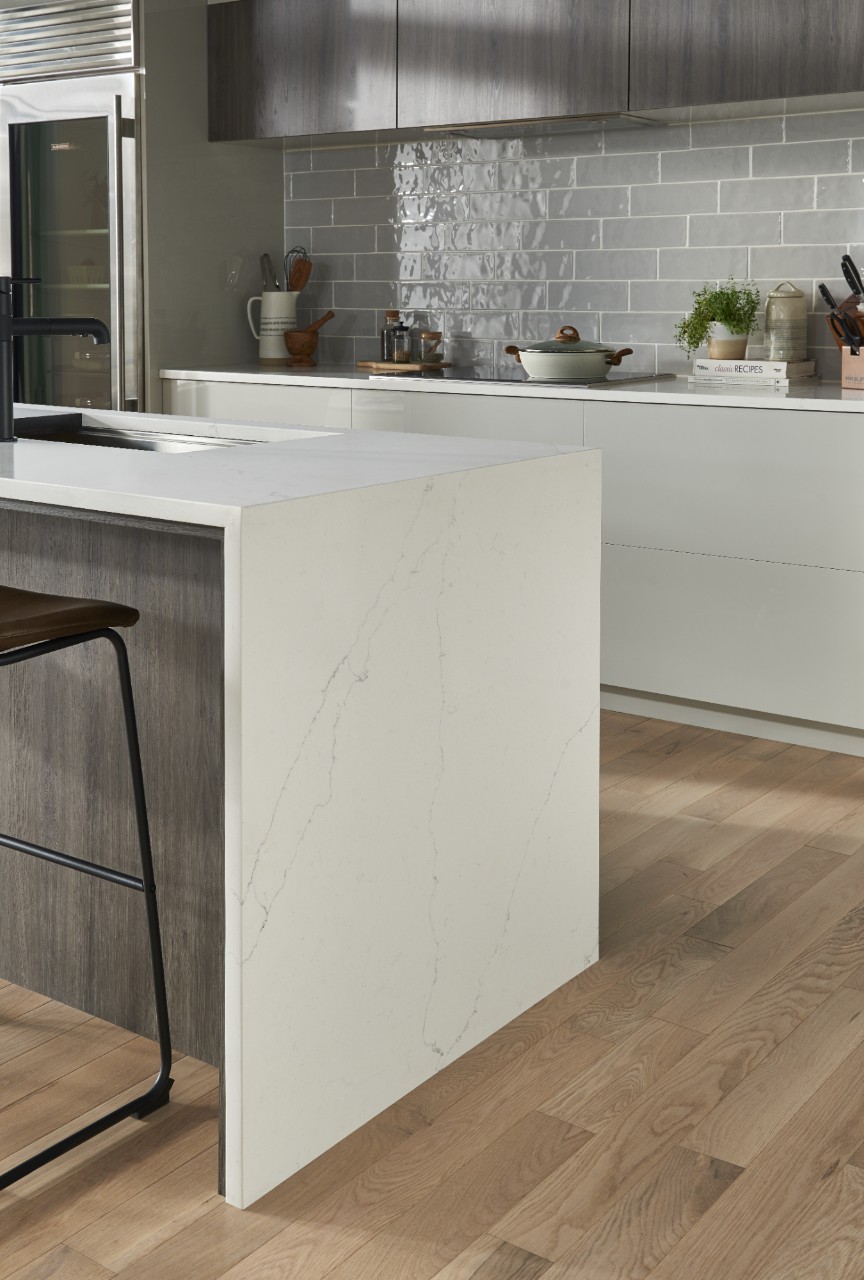
According to Distinctive Kitchen’s product report, the trend toward white quartz countertops is steadily growing as consumer preferences shift toward more basic, timeless material colors. According to Statista (2024), 50% of surveyed homeowners in the U.S. chose white as their preferred countertop color during kitchen renovations. This reinforces the growing popularity of white quartz as a go-to choice for modern kitchens.
Quartz is more budget-friendly than natural stone while still offering a wide range of elegant looks and premium quality. Plus, quartz requires less maintenance compared to natural stone options.
The Appeal of Basic Tones
White quartz countertops are increasingly popular for their ability to reflect light, making spaces feel brighter and more open. When paired with contrasting cabinet colors, they can create a truly inspiring kitchen atmosphere.
Stylish Variations
White quartz isn’t just plain white—many slabs feature eye-catching veining and patterns that add character and focal points to your kitchen or living space.
Depending on your aesthetic preferences, your choice may vary. Here are 10 standout slabs, ranked from minimalist to bold veining:
Top 10: Silestone Miami White
A classic white from Silestone. This nearly solid white surface pairs effortlessly with various materials and paint colors. Part of the Luxe Collection, Group B, priced from $60.00/sqft at Distinctive Kitchen. (Prices are for reference only. For detailed quotes and special offers, submit a request to Distinctive Kitchenhere.)
Another Silestone favorite, Stellar Snow offers a warmer white tone with subtle flecks that mimic natural stone. As the name suggests, it’s a blend of “stellar star” and “snow white.” Also in the Luxe Collection, Group B (from $60/sqft).
A soft white with hints of gray for a refined look that’s never dull. Delicate white veining adds a touch of elegance. Group B of Luxe Collection.
Top 7: Pacific Carrara Cloud
From Pacific Surfaces, Carrara Cloud features a soft white base with gentle gray undertones and cloud-like veining. Ideal for those seeking a subtle yet stylish white. Group A of the Luxe Collection (starting around $52/sqft).
Top 6: Viatera Nebulo
Warm white with cosmic-inspired patterns. Perfect for stargazers and anyone who loves unique designs. Easy to match with various color schemes. Group B.
Top 5: MSI Calacatta Duolina
From MSI, this white slab mimics marble with mostly single-line veining. Great for modern or minimalist styles that still want a touch of flair.
Inspired by Italy’s Dolomites, this quartz features refined gold and gray veining. The surface has a soft texture that maintains brightness while subtly masking dust and smudges.
Elegant white with cloud-like veining and mountain-inspired patterns. A premium choice in the Luxe Collection (from $99/sqft), ideal for modern kitchens with waterfall island countertops.
Top 2: MSI Calacatta Viraldi
Sophisticated white with flowing brown and green veining. Viraldi naturally mimics the famous Calacatta marble. Also in the premium segment.
Top 1: MSI Calacatta Ocellio
Not the most expensive, but a top pick by Distinctive Kitchen. Ocellio resembles the vast ocean with bold veining, giving the impression of natural stone rather than engineered quartz. Luxe Collection, Group E, priced from $85/sqft.
White is incredibly versatile, especially for countertops.
For contrast and a bold statement, pair with dark cabinets and backsplashes like navy, black, or deep brown.
For a bright, airy kitchen, opt for warm yellows, whites, or light grays.
Are You a Homeowner or Contractor in Ohio? Let Distinctive Kitchen help you kick off your kitchen renovation project. Just send us a quote request—it's free! Plus, don’t miss out on our weekly updated promotions.
Granite countertops have long been a favorite among Ohio homeowners for their durability, timeless appeal, and natural beauty. But what truly sets granite apart is its unique veining—no two slabs are ever the same. These natural patterns, formed over millions of years, give each countertop a one-of-a-kind look that adds depth and character to any kitchen. Whether you're remodeling a historic home in Clintonville or designing a modern space in Dublin, a granite slab with striking veining can become the centerpiece of your kitchen.
These styles offer soft movement and neutral tones, perfect for minimalist or classic kitchen designs.
1. Luna Pearl
A blend of gray, cream, and black speckles. Its fine texture and balanced tones make it ideal for transitional kitchens. Luna Pearl is known for its subtle elegance and ability to complement both light and dark cabinetry.
A semi-solid black granite with reflective specks of silver, brown, and green. Its consistent pattern and dark tone offer a sleek, modern look without overwhelming the space.
A mix of gray, white, and black minerals that create a uniform, speckled look. Caledonia is a versatile choice for homeowners seeking a neutral countertop with subtle movement.
These slabs feature dramatic patterns and rich contrasts—perfect for homeowners who want their countertops to be the focal point.
6. Antarctic White
A striking white granite with bold gray and black veining. Its high contrast and flowing patterns make it ideal for modern kitchens seeking visual impact.
7. Everest White
Bright white base with sweeping gray veins. Everest White brings a sense of movement and luxury, often used in high-end remodels.
8. Viscount White
A dynamic granite with swirling black and gray veins over a white background. Its dramatic texture adds depth and character to any space.
Deep black base with bold white and silver veining. Titanium granite is known for its high contrast and luxurious appearance, often chosen for statement islands or accent walls.
10. Crazy Horse
A unique blend of earthy browns, grays, and creams with unpredictable veining. Crazy Horse granite offers a rustic yet artistic look, perfect for eclectic or farmhouse-style kitchens.
Whether you’re drawn to the quiet elegance of Luna Pearl or the dramatic flair of Titanium, granite countertops offer endless possibilities. Each slab is a natural work of art, and choosing the right veining style can elevate your entire kitchen.
If you're in Ohio and want to explore these options in person, visit Distinctive Kitchen in Columbus. Their showroom features a wide selection of granite slabs, and their team can help you find the perfect match for your home.
Black countertops have become a favorite among Ohio homeowners looking to add elegance and contrast to their kitchens. Whether you're remodeling a historic home in German Village or updating a modern condo in downtown Columbus, black quartz offers a timeless look that pairs beautifully with a range of styles.
Their dark surface helps conceal stains, crumbs, and wear from daily use, making them ideal for busy kitchens. For Ohio homeowners who value both form and function, black quartz offers a sleek solution that stays looking clean longer. Many homeowners in Columbus and surrounding areas say black countertops give their kitchens a grounded, modern feel. The contrast with white cabinetry or light wood creates a balanced look that feels both fresh and timeless.
Black quartz countertops can elevate a kitchen’s design—but only when chosen and styled thoughtfully. Here are a few common missteps Ohio homeowners should watch out for:
Using high-gloss black in low-light kitchens Glossy finishes can reflect light unevenly and make a dim space feel even darker. In homes with limited natural light, a matte or honed finish may be a better choice.
Skipping contrast with cabinets and backsplashes All-black surfaces paired with dark cabinetry can make the kitchen feel closed in. Adding contrast—like white cabinets or light tile—helps balance the visual weight.
Overlooking fingerprint visibility Polished black quartz can show fingerprints and smudges more easily than lighter colors. For busy households, a textured or matte finish may reduce upkeep.
Choosing style over practicality Some black quartz designs look stunning but may not suit the kitchen’s layout or lighting. Always view slabs in person and consider how they’ll look in your space.
Avoiding these pitfalls ensures your black quartz countertops enhance—not overwhelm—your kitchen design.
Quartz countertop pricing in Ohio typically ranges from $65 to $120 per square foot, depending on the brand, color complexity, and fabrication details. This price usually includes:
Material cost
Fabrication and edge finishing
Installation
Additional costs may apply for:
Sink and cooktop cutouts
Plumbing disconnect/reconnect
Delivery fees
Installation Timeline: Most quartz countertops are installed within 7–10 business days after templating. Distinctive Kitchen offers efficient turnaround thanks to in-house fabrication and scheduling.
For Ohio homeowners ready to explore black quartz options in person, Distinctive Kitchen offers a wide selection of slabs from top brands like HanStone, MSI, Silestone, and Viatera.
Located at 4600 Bridgeway Ave, Columbus, OH, the showroom is open to walk-ins and appointments. With over 25 years of experience, Distinctive Kitchen provides expert guidance, in-house fabrication, and a commitment to quality craftsmanship. Stop by the showroom to see how each black quartz slab looks under real lighting. Touch the surface, compare finishes, and get expert advice tailored to your kitchen layout and style.
Quartz has become one of the most sought-after materials for kitchen countertops in Ohio homes. It’s engineered from natural quartz crystals combined with resins, creating a surface that’s both durable and visually appealing. Homeowners appreciate its resistance to stains and scratches, as well as the wide range of colors and patterns available. Unlike granite or marble, quartz doesn’t need sealing, making it easier to maintain over time. Its consistent appearance also appeals to those looking for a clean, modern aesthetic.
What Influences the Cost of Quartz Countertops?
In Ohio, quartz countertops typically cost between $60 and $120 per square foot, including fabrication and installation. Several factors contribute to this range:
Material quality: Higher-end brands like HanStone offer more durability and design options, which can increase the price.
Color and pattern complexity: Unique or rare designs often come at a premium.
Edge profiles and custom cuts: More intricate designs require additional labor and precision.
Installation details: Features like backsplashes, sink cutouts, and appliance integration can affect the final cost.
Quartz countertops at Distinctive Kitchen are available in multiple pricing levels, allowing homeowners to choose a product that fits both their design preferences and budget. These levels are based on the brand, color complexity, and finish of the quartz. The Luxe Collection is a stock color collection that gives you the best price and the fastest installation.
Price Group
Price Range (per sq. ft.)
Value Series
$43.50
Group A
$52.00
Group B
$60.00
Group C
$68.00
Group D
$75.00
Group E
$85.00
Group F
$99.00
These tiers apply to Distinctive Kitchen’s in-house and partner brands, including HanStone, Silestone, Cambria, and Caesarstone. Each group offers a curated selection of colors and styles, with Group F representing the most premium offerings, often featuring dramatic veining and marble-like aesthetics.
One of the biggest advantages of quartz is its minimal upkeep. Unlike granite or marble, which require regular sealing, quartz can be cleaned with mild soap and water. There’s no need for special treatments or expensive cleaners.
This simplicity reduces ongoing maintenance costs and makes quartz a practical choice for busy households. It also helps preserve the countertop’s appearance for years without the need for refinishing.
Estimating Your Budget
When planning for quartz countertops, consider the following:
Kitchen size: Larger spaces require more material and labor.
Design preferences: Specialty colors or edge profiles may increase costs.
Installation complexity: Features like waterfall edges or integrated sinks can add to the total.
Distinctive Kitchen offers options for a range of budgets, helping homeowners find the right balance between style and affordability. Their team provides detailed estimates and guides clients through the selection process.
Choosing a reliable fabricator is just as important as selecting the right material. Distinctive Kitchen has over 25 years of experience serving homeowners in Central Ohio. They handle every step of the process—from design to installation—without outsourcing, ensuring quality and consistency. Their showroom features dozens of quartz styles, and their in-house team is available to answer questions and provide personalized recommendations.
Taj Mahal countertops have earned a top spot in today’s kitchen design trends, delivering the look of marble. Named after India’s iconic monument, this natural stone brings a touch of that grandeur into your home. In this comprehensive guide, we’ll answer common questions about Taj Mahal Quartzite – covering its characteristics, durability, maintenance, cost, and stylish pairings – and compare it to modern quartz alternatives like Taj Duna™. Read on to discover why Taj Mahal Quartzite is a premium choice for countertops, and how to make the most of its beauty in your kitchen.
1. What is Taj Mahal Countertop?
Taj Mahal countertop is a 100% natural stone – a metamorphic rock formed from ancient sandstone under intense heat and pressure. Quarried primarily in Brazil, each slab is unique, showcasing nature’s artistry in its veining. Homeowners love Taj Mahal Quartzite because it offers:
Marble-like elegance: a soft, luminous appearance with gentle veining, reminiscent of high-end marbles.
Granite-like strength: exceptional hardness and durability (Mohs ~7+), so it resists scratching, etching, and heat better than marble and even many granites.
Timeless versatility: a neutral palette that fits modern, classic, or transitional kitchens alike.
In practical terms, Taj Mahal Quartzite brings a rare combo of beauty and brawn to your space. It’s popularly used for kitchen countertops and islands, but also for bathroom vanities, bar tops, and even fireplace surrounds because of its durability. If you’ve dreamed of marble counters but worry about upkeep, Taj Mahal can be an ideal solution – you get that elegant look without the constant worry. Beside, Taj Mahal also has laminate (provided by Formica).
2. What Does Taj Mahal Quartzite Look Like?
Visually, Taj Mahal Quartzite is prized for its soft, neutral beauty. The base color is typically a creamy off-white or warm beige, overlaid with delicate veins of gray, gold, taupe, or ivory. Key characteristics of its appearance include:
Subtle, wispy veining: Unlike the bold stripes of some marbles, Taj Mahal’s veins are often feathery and soft. They meander gently across the slab, giving it movement without overwhelming the eye. In some slabs you might see hints of pearly silver in cooler-toned sections, or honey-gold accents in warmer areas.
Neutral warmth: The overall tone is warm but not yellowish. This stone manages to be warm and inviting while still looking clean and elegant. In certain lots, you may notice tiny mineral flecks that shimmer, adding depth when light hits the surface.
Finish options: You can choose different surface finishes for Taj Mahal Quartzite:
Polished – the most common finish, high-gloss and reflective, which enhances the colors and makes the veins pop.
Honed – a matte, smooth finish that gives a softer, more subdued look (less reflection).
Leathered – a textured, low-sheen finish that you can feel, adding a rustic or natural touch.
Most homeowners opt for polished to showcase the stone’s luminescence, but honed Taj Mahal is gorgeous for a calmer, satin effect. A leathered finish can bring out subtle dimensionality in the veins – great for a unique, tactile feel.
Translucence: Taj Mahal is slightly translucent in lighter sections, which means under certain lighting (or if you were to backlight a thin slice) it can glow. This isn’t usually exploited in a thick counter, but it’s a testament to the stone’s crystal-rich composition.
3. How Durable Are Taj Mahal Countertops?
In one word: very! Taj Mahal Quartzite’s durability is a major attraction – it’s often described as a “low-maintenance luxury” surface because it can handle the realities of a busy kitchen. Here’s how it performs on key durability factors:
Hardness & Scratch Resistance: Quartzite is one of the hardest natural countertop materials. Taj Mahal typically measures around 7 to 7.5 on the Mohs hardness scale (diamonds are 10). This means normal kitchen use won’t scratch it. You can cut directly on it, but you’ll likely dull your knives before you scratch the counter! Pots, pans, and dishes sliding around are unlikely to leave marks. In fact, it’s harder than many granites, so it stands up to wear and tear exceptionally well.
Heat Resistance: Because it’s formed under high heat, quartzite can endure high temperatures. You can place a hot pan on Taj Mahal briefly with less risk of a scorch mark (unlike a plastic-based countertop or even some quartz which can warp). Of course, the safe practice is to use trivets for anything extremely hot to avoid thermal shock. But generally, hot cookie sheets or pots won’t faze this stone – a big plus for avid cooks.
Chip & Impact Resistance: The density and strength of Taj Mahal help prevent chips. The edges and corners are the most vulnerable (as with any stone), but compared to softer stones like marble or soapstone, quartzite is far less likely to ding or dent if you accidentally drop a heavy object on it. Homeowners with active kitchens (kids, heavy cookware) appreciate that resilience.
Etch Resistance (Acids): Etching is the dull spot that acids can cause on calcite-based stones (like marble). Quartzite, including Taj Mahal, is mostly silica – it’s highly resistant to acids. In fact, in a real-life test, researchers left lemon juice, vinegar, even ketchup on a Taj Mahal sample for 15 hours, and no etching occurred. That’s extraordinary – marble would have shown numerous dull spots in that scenario. So, you don’t have to panic if someone squeezes a lime on the counter or a splash of vinegar sits for a bit. (Still, best practice is to wipe acidic spills reasonably soon.)
Stain Resistance: Being a natural stone, Taj Mahal is porous to a degree. However, when properly sealed (more on sealing below), it becomes very stain resistant. In tests, sealed Taj Mahal Quartzite had no stains from red wine, coffee, or olive oil even after 30 minutes and overnight exposure. The olive oil didn’t darken it, which is impressive. Unsealed, if you left oil or wine overnight, it might absorb slightly – but with a good sealer, everyday substances won’t penetrate. This performance is why many call Taj Mahal a low-maintenance stone compared to marble (which can both stain and etch easily).
4. How Much Does Taj Mahal Quartzite Cost?
Taj Mahal Quartzite is a premium product, and its price reflects that. It’s often categorized as an “exotic” stone due to its refined look and import origin. Here’s what to expect:
Installed Cost Range: On average, Taj Mahal Quartzite countertops cost around $90 to $150 per square foot installed. Prices can vary based on your region, the particular slab (exceptional lots can command higher prices), and project specifics. At Distinctive Kitchen (Columbus, OH), Taj Mahal falls into our top pricing tier (Group F) which is roughly $~$99/ft² installed, but prices elsewhere might be higher especially if demand is high or supply is limited.
Why the high cost? Several factors drive the cost:
Material Rarity: It’s quarried in limited regions and each slab is unique. High demand for its look has made it sought-after worldwide.
Slab Size: Taj Mahal often comes in large slab formats (which is good for fewer seams). Larger slabs cost more and minimize waste.
Thickness:3cm (1-1/4”) slabs are standard for kitchen counters and tend to be pricier than 2cm (3/4”) slabs because they’re thicker and heavier. Most installations use 3cm for durability and the nice finished edge profile.
Finish & Fabrication: A polished finish is usually standard, but if you opt for a honed or leathered finish, there might be an upcharge for the extra labor to achieve that texture. Also, complex edge profiles (like an ornate ogee edge or a double-thickness mitered edge) add fabrication time and cost. Similarly, if your design includes full-height backsplash slabs, waterfall ends, or requires careful vein-matching at seams, the labor costs can be higher.
Installation complexity: Additional elements such as cutouts for farm sinks, custom cooktop cuts, or a lot of corners and seams might increase the installation labor slightly.
5. What Are the Alternatives? (Quartz Look-alikes and Other Stones)
Thanks to Taj Mahal Quartzite’s popularity, several manufacturers have created engineered quartz countertops that emulate its appearance. These quartz alternatives are man-made surfaces (about 90-95% ground quartz plus resins) and offer their own benefits. The most relevant ones include:
Taj Duna™ Quartz: This is a premium quartz color (by LG Viatera) inspired specifically by Taj Mahal Quartzite. It’s designed to “capture the essence” of Taj Mahal’s warm tones and soft veining. Taj Duna has a creamy-beige base with light golden-brown veins, strikingly similar to natural Taj Mahal. The pattern is consistent and even through the slab (Viatera uses a thru-body veining on Taj Duna, so the design carries through edges). If you saw Taj Duna and Taj Mahal side by side, you’d be impressed how close the quartz comes. From Distinctive’s Luxe Collection brochure: “Inspired by the timeless elegance of Taj Mahal quartzite, Taj Duna displays warm, earthy tones and soft veining for a refined, luxurious aesthetic.” In pricing, Taj Duna quartz is cheaper – roughly $60–$90 per sq. ft. installed (we price it in Group D, around $75 at Distinctive).
Calacatta Quartz (Marble-look quartz): These aren’t made to copy Taj Mahal specifically, but they achieve a similar vibe: white or off-white background with dramatic veining. Examples are Calacatta Gold quartz (white with gold and gray veins) or Calacatta Laza (soft white with subtle long gray/gold veins). They tend to be a bit cooler (more gray) or bolder in pattern than Taj Mahal’s gentle beige, but serve the same design purpose of a light, elegant counter. Many brands (Silestone, MSI, Cambria, etc.) have their own Calacatta-inspired offerings. Prices are usually mid-range (often in the $70–$120 per ft² installed, depending on brand and style).
These natural options vary in availability and price, but it’s good to know Taj Mahal isn’t the only gorgeous light quartzite out there. If you love Taj Mahal’s look, you will likely love these too – and they share similar maintenance profiles.
6. What Cabinets and Backsplashes Pair Well with Taj Mahal?
One of the reasons Taj Mahal Quartzite is an interior designer’s favorite is its ability to complement a wide variety of kitchen styles and color schemes. Its neutral, warm-yet-crisp look means it can anchor your design without clashing. Here are some cabinet and backsplash ideas to make Taj Mahal countertops shine:
Cabinet Color Ideas
Classic White or Off-White Cabinets:White cabinetry with Taj Mahal counters creates a bright, timeless look. The white picks up the lighter tones in the quartzite, making the whole kitchen feel larger and cohesive. For a slightly softer feel, go with off-white, ivory, or cream cabinets that echo the stone’s warmth. This monochromatic scheme is elegant and lets the countertop’s subtle veins become a gentle focal point.
Natural Wood Cabinets: Taj Mahal pairs beautifully with wood grains. Light to medium wood tones like white oak, maple, birch, or walnut create an inviting, organic ambiance. The warm beige in the stone complements the wood’s warmth. For example, flat-panel white oak cabinets plus a Taj Mahal countertop yield a stunning Scandinavian-modern look. Wood cabinets also bring out the subtle taupe veins in the stone. This combo feels high-end yet cozy.
Two-Tone Kitchens: A popular trend is using two cabinet colors – e.g., one for the island and another for perimeter cabinets. Taj Mahal works great here: Try a dark espresso or navy blue island with Taj Mahal on top, and white or light perimeter cabinets. The island’s dark color will make the creamy quartzite pop, highlighting its veining, while the perimeter in white ties back to the stone’s background color. This adds visual interest and really draws attention to the island as a centerpiece.
Gray or Greige Cabinets: Soft greige (gray-beige) or light warm gray cabinets can also pair nicely. Since Taj Mahal has some gray undertones in its veins, a matching gray cabinet can pull that out. The key is to choose a warm-gray so it doesn’t feel too cold. A dove gray cabinet with Taj Mahal gives a sophisticated, understated palette – elegant and understated. Avoid very cool bluish grays, as they might clash with the stone’s warmth; a hint of beige in the gray (i.e., greige) is ideal.
Deep Colored Cabinets: For a bold contrast, some homeowners opt for deep charcoal, forest green, or black cabinets with Taj Mahal counters. This can be dramatic and luxurious. The rich cabinet color makes the creamy Taj Mahal visually “pop” and prevents the dark kitchen from feeling too heavy (since the counters and backsplash will add lightness). If you go this route, incorporate brass or gold hardware to echo the gold veins in the stone – a designer trick that ties the look together and adds warmth.
Backsplash Ideas
Matching Quartzite Slab Backsplash: For pure luxury, use Taj Mahal itself as the backsplash, running the same slab up the wall. This provides a seamless look and showcases the stone’s veining uninterrupted – the effect is jaw-dropping when executed well. It’s also practical (few grout lines to clean). Distinctive’s fabricators can align the veins from counter to backsplash with precision, so it looks like a continuous sheet of stone.
Classic Subway Tile: You can’t go wrong with white subway tiles (glossy ceramic or glass) as a backsplash. It’s a classic, clean backdrop that allows the Taj Mahal countertop to stand out. For more harmony, consider an off-white or beige subway tile that matches the stone’s base color. The slight warmth in the tile will blend with the Taj Mahal for an elegant, unified look. This is a cost-effective and timeless option.
Neutral Mosaic or Patterned Tile: If you want a bit more texture or pattern, explore marble or quartzite mosaic tiles. For example, a Carrara marble herringbone mosaic or a beige arabesque tile can add visual interest while the colors complement Taj Mahal. Marble mosaics with mixed white and gold pieces can echo the stone’s veins. Just stick to neutral tones (white, cream, soft gray, pale gold) so it doesn’t overpower the counter.
Glass Tile in Soft Tones:Glass backsplash tiles in a champagne, ivory, or light gray can be lovely. They add a hint of shine and modernity. A light greige glass subway tile could pick up the stone’s hues subtly. Glass also reflects light, enhancing the kitchen’s brightness – nice if your Taj Mahal is polished and reflective too.
Accent Backsplash Ideas: Some adventurous designs incorporate a bold accent behind the range or a portion of the backsplash (like a patterned tile inset) to add personality. For instance, a section of moroccan pattern tile in white/gold behind the cooktop could play off Taj Mahal’s gold veins. Or a band of brass or stainless steel tile for a modern bling. Use sparingly so it remains elegant.
Flooring Ideas
Don’t forget the floor! Taj Mahal’s versatility extends downward:
Hardwood Floors: You almost can’t miss with mid-tone hardwood floors (oak, hickory, etc.). The natural wood looks great with the natural stone – think of the stone’s beige veins aligning with the wood’s brown tones. Lighter woods (like natural oak or maple) will keep the kitchen feeling light and spacious, whereas medium/dark woods (walnut, mocha-stained oak) will create a rich, intimate atmosphere where Taj Mahal provides contrast.
Luxury Vinyl Plank (LVP): If you prefer durable vinyl flooring, choose an LVP in a warm gray or soft brown wood look. Many LVP options have greige tones that would tie into Taj Mahal’s coloring nicely. These are budget-friendly and practical while still looking good with the counters.
Stone or Tile Floors: For a very high-end look, consider natural stone or porcelain tile in a complementary color. Beige or cream porcelain tile, honed travertine, or light limestone flooring can echo the counter’s tones for a cohesive, earthy feel. Just avoid anything too busy or with clashing undertones (e.g., a tile with a lot of red in it might not jive with Taj’s gold/gray).