Over the past decade, kitchen surfaces have shifted from natural granite toward engineered quartz, and within that shift, the marble-look “Calacatta” pattern has become the most-wanted design of all. Silestone Eternal Calacatta Gold, made by Cosentino, is one of the colors that defined the category. It gives you the opulent look of Italian marble without the staining and etching — and as a fabricator that installs a lot of it here in Columbus, we’ll walk you through what it’s really made of, how it performs, what it costs, and where it makes sense.
1. What is Silestone Eternal Calacatta Gold?
It’s an engineered quartz surface from Silestone’s premium Eternal collection, built to solve marble’s biggest weakness: porosity. Natural marble looks luxurious but stains and etches easily; Eternal Calacatta Gold delivers the same visual richness in a non-porous, far more durable surface. What sets it apart from older quartz is a pair of Cosentino technologies — HybriQ+ (composition and sustainability) and N-Boost (surface chemistry) — which we’ll cover below.


Silestone Eternal Calacatta Gold full slab. Image: Cosentino.
2. What it looks like — background, veining & finishes
The reason this color works so well is that it balances drama with livability:
- A warm-white canvas: instead of the stark, clinical white of many competitors, the base is a warm, slightly translucent white — which keeps it from looking sterile under normal home lighting.
- Elegant veining: it skips the heavy, ropey black veins of some marble-look quartz in favor of wide, soft grey highlights with unexpected golden glints.
- The “gold” nuance: the gold isn’t metallic or glittery — it’s a subtle, organic beige-bronze that mimics the natural oxidation in real marble, which is what keeps the look refined rather than kitsch.
It comes in two finishes that change how light hits the veining:
- Polished: high-gloss and reflective, with deeper-looking color. Best for classic or glam kitchens, and for small spaces where bouncing light around matters.
- Suede (matte): a soft, velvety texture that diffuses light for a “soft focus” effect — popular for organic-modern and Japandi looks. Note that suede needs a bit more cleaning attention, since oils can sit in the texture.

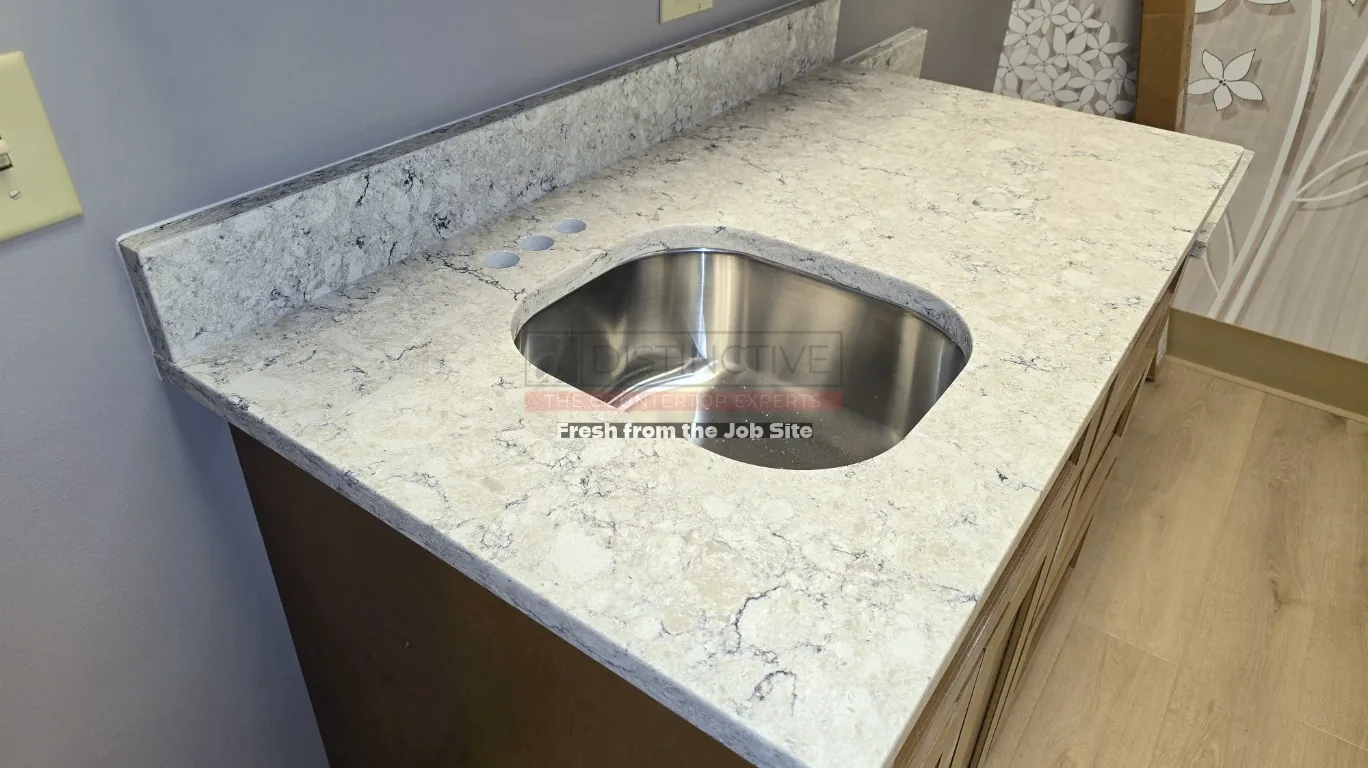
Eternal Calacatta Gold finishes: polished and suede. Image: Distinctive Kitchen.
3. The technology: HybriQ+ and N-Boost
Part of what justifies the premium price is the engineering inside the slab.
HybriQ+ — lower silica, more sustainable
The engineered-stone industry has faced real concerns about crystalline silica and fabricator safety. Silestone’s response is HybriQ+ technology:
- Low silica: slabs are labeled Q40 (max 40% silica) or Q10 (max 10%) — a big reduction from the traditional 90%+ in older quartz.
- Cleaner manufacturing: the process uses 99% reused water and 100% renewable electricity.
- Recycled content: a hybrid mineral formula with a minimum of 20% recycled materials.
N-Boost — surface chemistry
N-Boost is a surface treatment that modifies the slab at a molecular level. It makes the white background read brighter by reflecting light more uniformly, and it makes the surface hydrophobic — liquids bead up instead of spreading, which improves stain resistance and makes cleaning easier.
>>> See the Luxe Collection: stocked countertop colors at Distinctive Kitchen
4. Performance and limitations
Hardness
It’s engineered for resilience, with a Mohs hardness around 6–7. For context, a steel knife is about 5.5 and natural marble is 3 — so it shrugs off normal food prep without scratching.
Heat resistance — the real limitation
A common myth is that quartz is heat-proof. It isn’t. The resin binder can scorch, discolor, or suffer thermal shock above roughly 300°F (149°C), so setting a hot pan straight from the stove onto the surface can cause permanent damage. Using trivets or hot pads isn’t just good practice — it’s required for warranty compliance.
Chemical resistance
- Acids: excellent — lemon juice, vinegar, and wine won’t etch it (unlike marble).
- Alkalis: this is its weak point. High-pH substances (above ~pH 10) like bleach, oven cleaners, and paint strippers can attack the resin binder — avoid them entirely.

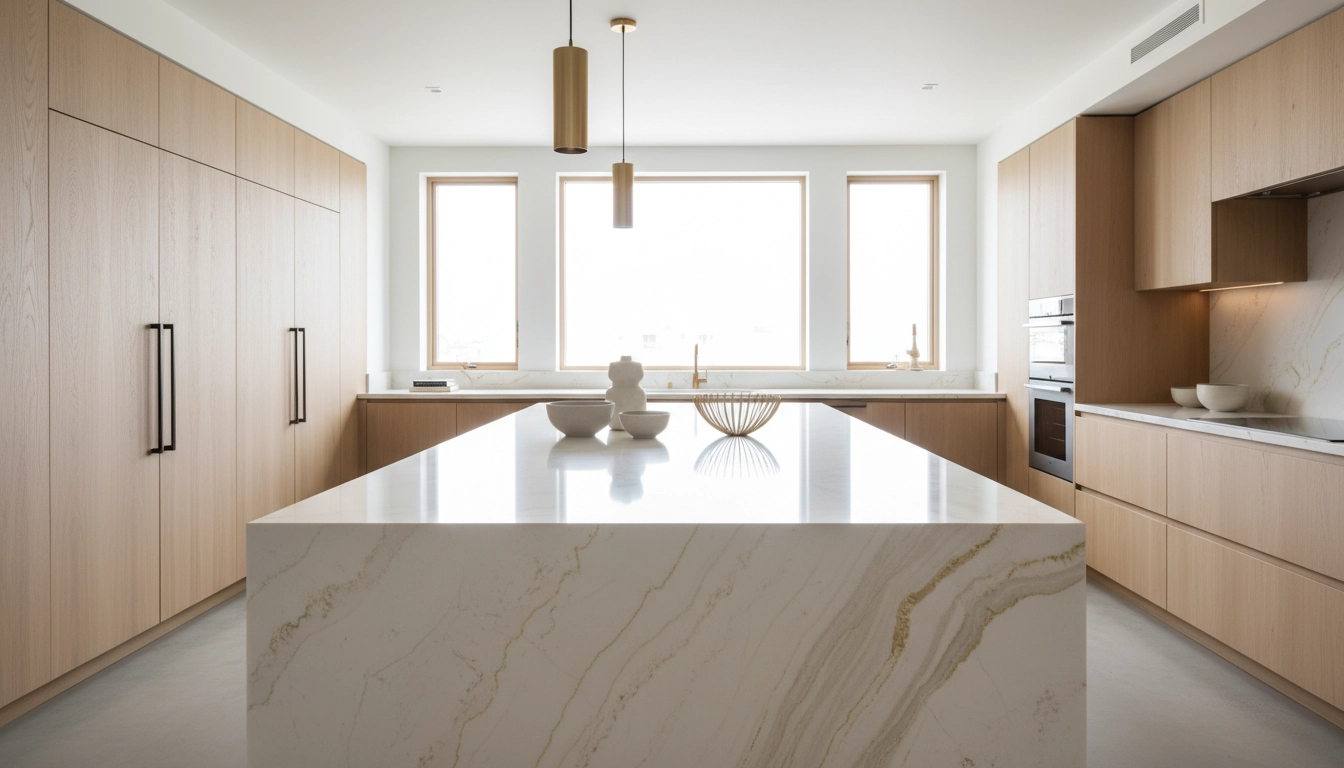
Eternal Calacatta Gold island. Image: Distinctive Kitchen actual job.
5. Designing with it: cabinets & backsplash
Cabinet coordination
Because the background is a warm white, pairing it with the wrong white can create “clashing whites.” A few combinations we’ve seen work:
- White cabinets: use a neutral-to-warm white — Benjamin Moore Chantilly Lace for a clean match, or Sherwin Williams Pure White to bridge the background and gold veins.
- Grey / greige: the grey veins connect naturally to greige cabinets like Sherwin Williams Repose Gray.
- Wood tones: the beige-gold veining makes it especially good with white oak (coastal/Scandinavian) or walnut (mid-century modern). For more, see what countertop colors look best with white cabinets.
Backsplash
- Full slab: running the Silestone up the wall is the most premium look, letting the veining flow uninterrupted.
- Avoid: placing real Calacatta marble tile next to the engineered quartz — the natural chaos of the marble tends to highlight the regularity of the quartz.
>>> Explore the ultimate guide to Silestone and our 8 best Silestone colors

Eternal Calacatta Gold kitchen. Image: Distinctive Kitchen.
6. Cost
Eternal Calacatta Gold sits in the premium tier:
- Standard installation: roughly $75–$130 per square foot installed.
- Complex installation: can rise to $130–$180+ for mitered edges or waterfall legs (see choosing an edge profile).
- Value: the upfront cost is higher than entry-level quartz (~$50/sq ft), but the 25-year warranty and brand equity hold long-term value. Our stocking program also places it in a more accessible tier than many competitors — see quartz pricing in Ohio.
7. Maintenance & warranty
- Routine cleaning: pH-neutral dish soap (like Dawn) and warm water with a microfiber cloth. Full routine in how to clean quartz countertops.
- Avoid: undiluted bleach, oven cleaners, and abrasive scrubbers like steel wool — these damage the resin and can void the warranty.
- Warranty: Cosentino offers a 25-year limited transferable warranty covering manufacturing defects (it excludes heat, chemical, and impact damage). Distinctive Kitchen adds a 1-year installation warranty.
8. The verdict
Eternal Calacatta Gold bridges the look of Italian marble with the performance of modern engineered stone. Two quick comparisons:
- vs. a budget marble-look quartz: a high-contrast, lower-cost option can run 20–30% cheaper; choose Eternal Calacatta Gold for a more refined, low-silica luxury with superior surface technology.
- vs. natural marble: choose the Silestone if you want the look to stay pristine for 20+ years without worrying about etching and staining.
For a “forever kitchen,” it’s an investment in livable luxury — the marble look with stain resistance and durability that earns its premium price.
Get an instant installed price, or visit our Columbus showroom to compare polished and suede finishes in person.
Get my Calacatta Gold quote → Visit the showroom