
Quartz Waterfall Countertops Are Redefining Kitchen Luxury
Quartz waterfall countertops are everywhere in modern kitchen design right now — that sleek, continuous flow from the horizontal top down the vertical sides of an island. It’s a bold, architectural look that pairs elegance with durability, and here in Columbus it’s one of the fastest-growing requests we get, especially for the open-concept islands in newer Dublin, Powell, and New Albany homes. Here’s what a waterfall countertop is, why quartz suits it so well, what it costs, and how to get it right.
1. What is a quartz waterfall countertop?
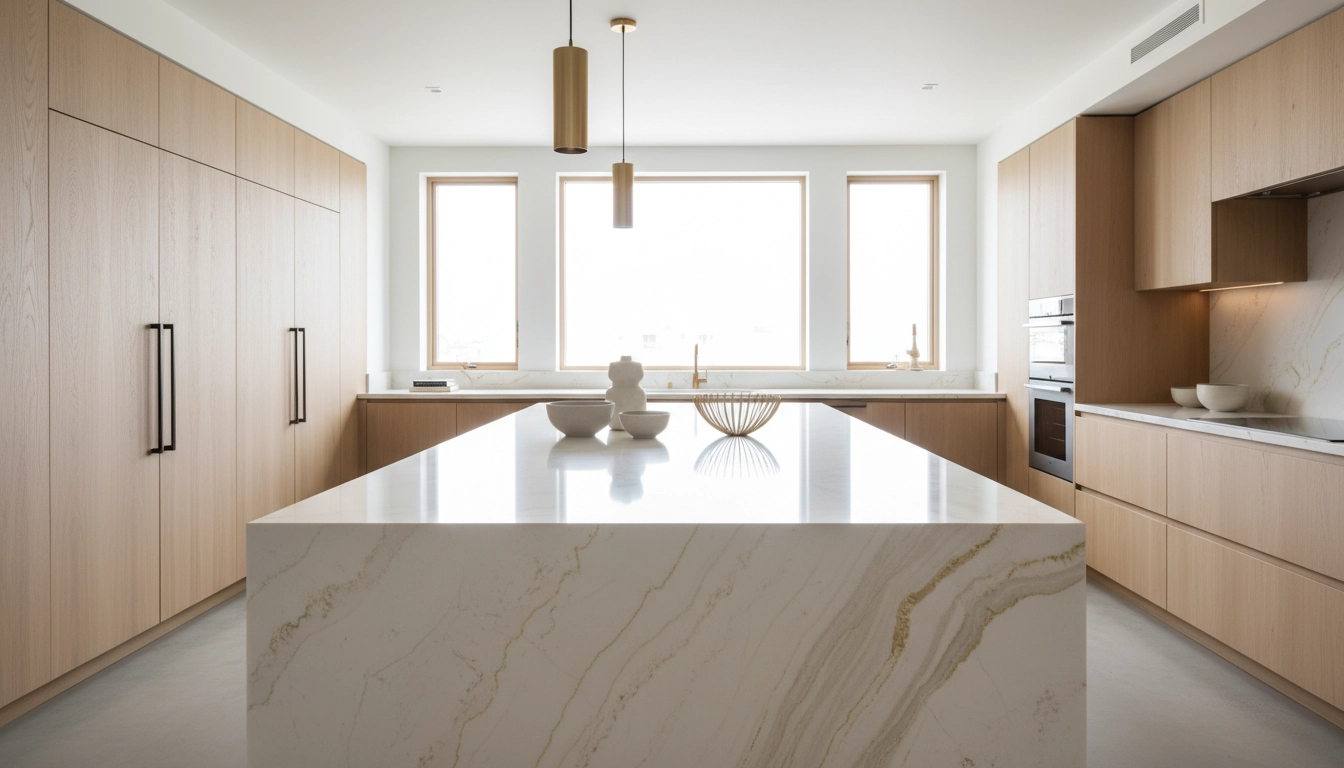
A waterfall countertop extends the surface material vertically down the side(s) of an island or cabinet run, creating a seamless “cascading” effect to the floor. In quartz, it gives a clean, modern look while showing off consistent veining and color. As Jonathan Rupert, owner of Distinctive Kitchen, puts it: “A waterfall kitchen countertop is where the stone wraps around both the top and side or sides of an island or the end of a cabinet run. It gives a more finished, bespoke look to the kitchen.”
2. Why quartz is the ideal material
Quartz is engineered from natural minerals blended with resins and pigments, making it durable and consistent — which matters enormously for a waterfall, where the pattern has to turn a 90-degree corner and still look like one continuous piece. Designers favor it for waterfall edges because:
- Seamless appearance: quartz can be fabricated to match veining across the joint where top meets leg.
- Low maintenance: non-porous, stain-resistant, and never needs sealing.
- Design flexibility: a huge range of colors and finishes, including marble-like veining.
Mor Krisher, Head of Design at Caesarstone, notes: “Quartz allows you to create a waterfall countertop that looks like one cohesive material. It’s easier than any other material to make it look cohesive from horizontal to vertical surface.” This is exactly why we steer clients toward an engineered surface rather than natural stone for a waterfall — the predictable pattern is what makes the corner read as seamless. (More on the material trade-offs in quartz vs granite.)
Beyond looks, there are practical wins: the vertical slab protects cabinet ends from wear in high-traffic kitchens, and it gives open-concept layouts structure and symmetry, turning an island into a true focal point.
>>> Browse 800+ quartz countertops at Distinctive Kitchen
3. Popular styles and color trends
3.1. Clean and minimalist
Straight edges, minimal veining, monochromatic tones — best for Scandinavian, modern, and minimalist kitchens. Picture a white quartz waterfall island with subtle speckles against matte-black cabinetry.

3.2. Graphic and bold
Dramatic veining and high contrast — for contemporary, statement kitchens. A Calacatta-style quartz with grey veins flowing over the edge makes a showstopping centerpiece.
>>> Color suggestion: Viatera Sierras — marble-look quartz

3.3. Asymmetrical waterfall
A waterfall edge on one side only — best for small kitchens or open layouts where visual balance matters. Think a single waterfall leg paired with a breakfast bar on the opposite side.

3.4. Mixed materials
Quartz combined with wood, brass, or tile — best for eclectic or transitional designs. A quartz waterfall island with a built-in walnut breakfast bar is a look we see often in transitional Upper Arlington and Worthington remodels.
4. Cost considerations
A waterfall adds material and fabrication labor because you’re covering the vertical sides too, and the corner miter takes skilled work. Rough Columbus-market ranges (material + fabrication + install):
| Size / scope | Approx. area | Basic quartz | Mid-range | Premium / multi-side |
|---|---|---|---|---|
| Small island, 1 waterfall side ~30 sq ft top + ~10 sq ft side | ~40 sq ft | $2,800–$4,000 (≈ $70–$100/sq ft) | $4,000–$5,500 | $5,500–$7,500+ |
| Medium island, waterfall both ends ~50 sq ft top + ~20–25 sq ft vertical | ~70–75 sq ft | $5,000–$7,500 | $8,000–$10,500 | $11,000–$14,000+ |
| Large island, both sides, premium slab ~80–90 sq ft top + ~50 sq ft sides | ~130–140 sq ft | $9,000–$12,000 | $13,000–$17,000 | $18,000–$22,000+ |
Thickness affects both look and cost — see our 2cm vs 3cm guide (3cm is the usual choice for a substantial waterfall), and the full quartz pricing breakdown for Ohio.
>>> Not sure what a waterfall would cost for your island? Get a free instant quote.
5. Expert tips for a seamless look
- Bookmatch the veining so the pattern flows continuously over the corner.
- Choose eased or radius edges to soften the look and reduce wear.
- Opt for 3cm slabs for a more substantial, luxurious feel (see edge profile guide).
- Coordinate with cabinetry and flooring to keep the space balanced.
A couple of practical cautions we always raise with clients: a waterfall leg can reduce cabinet access or storage on that end of the island, so balance the look against how you actually use the space. And large islands may need added structural support for the weight of the stone — something our fabrication team plans for during templating.
Done right, a quartz waterfall isn’t just a trend — it’s a way to make an island feel curated and bespoke. With the right slab and skilled fabrication, it can become the defining feature of your kitchen.
Thinking about a waterfall island?
As Columbus’s largest countertop fabricator, we handle the precise miter and vein-matching a waterfall demands. Get an instant installed price, or visit our showroom near John Glenn International Airport to see waterfall edges in person.
Get an instant quote → Visit the showroom